Transforming Professional Learning, Together
Join a community of learners and educators to revolutionize the way we learn.

Join a community of learners and educators to revolutionize the way we learn.

Instructional design applies research-backed principles to develop training programs that deliver measurable results. It's the strategic process of designing learning solutions that close knowledge gaps and build the skills your organization needs to succeed.

Assessing the learning needs and goals of clients or organizations to determine the most appropriate instructional solutions.

Improving the usability and effectiveness of instructional materials by optimizing user interfaces, navigation, and interactivity.

Developing comprehensive curriculum plans and frameworks for courses, training programs, or educational materials.

Selecting and implementing appropriate instructional technologies and learning management systems (LMS) to deliver and manage content effectively.


.png/:/rs=w:370,cg:true,m)
.png/:/cr=t:0%25,l:0%25,w:100%25,h:100%25/rs=w:370,cg:true)
Check out this great video
I believe in:
Please reach us at if you cannot find an answer to your question.
In response, the designer might explain the principles of instructional design and how they can be applied to various learning contexts to enhance engagement, comprehension, and retention. They could also provide examples of successful instructional design projects relevant to the client's industry or objectives.
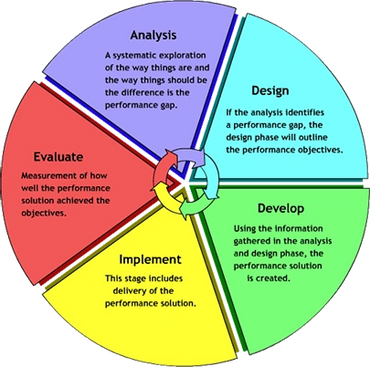
Phases of instructional design include: analysis, design, development, implementation, and evaluation (ADDIE model), along with other iterative models such as SAM (Successive Approximation Model) or Agile. They could offer insights into each phase and how they collaborate with clients to ensure alignment with learning goals and objectives.
Here, the designer might discuss the principles of Universal Design for Learning (UDL) and strategies for creating inclusive learning experiences that address different learning styles, abilities, and backgrounds. They might highlight examples of accommodations, such as multimedia formats, interactive elements, or alternative assessments, that can be integrated into instructional materials to support diverse learners effectively.
If you're unsure about what type of training will work best for you, just tell us a little more about your needs. We will get back to you as soon as possible with the answers you need!
Sign up to hear from us about specials, sales, and events.
We use cookies to analyze website traffic and optimize your website experience. By accepting our use of cookies, your data will be aggregated with all other user data.